Search for evidence.
Ask for a supported conclusion.
Searchable documents, episodes, claims and subject knowledge give agents and people a shared basis for the next question. Answers carry their evidence with them.
The shared intelligence control plane for AI agents
Every agent informed.
Every action visible.
Turn agent activity into durable memory, coordinate work across systems, and give people a complete operational view.
From activity to shared intelligenceFrom isolated sessions to shared intelligence
Claude Code in one terminal. Codex in another. Headless jobs in containers. Each session learns something, but the knowledge too often disappears when the window closes.
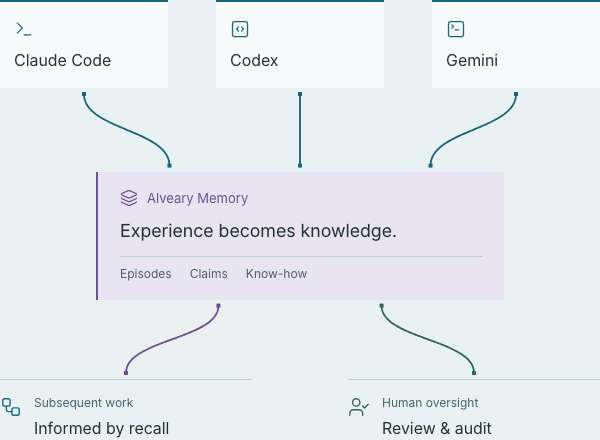
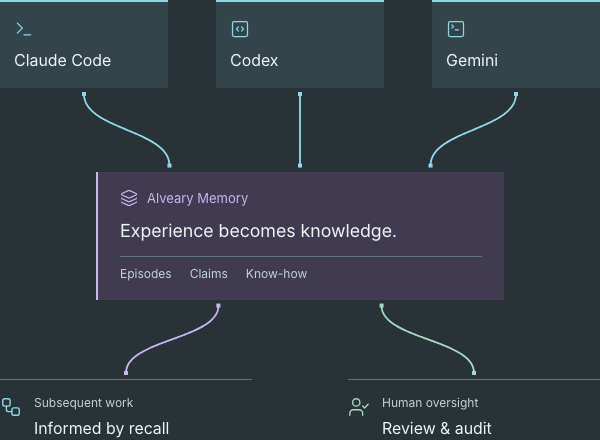
Alveary turns that experience into knowledge the organisation can keep and reuse. Agents retain their own models, tools, permissions and workspaces. What they gain is a common memory, a common queue and a common picture.
One install command per host. Claude Code, Codex and Gemini use the same collector and event contract.
Session hooks capture activity without making the agent wait on the network. Events, token usage and telemetry are normalised, stored and shown live.
Experience becomes searchable documents, episodes, claims and subject knowledge. Search returns evidence; Ask adds a conclusion with the evidence attached.
Route the next prompt and the next model job. Policies, reviews and admissions keep people in control of what is remembered and done.
01 / Remember collectively
Improving agents does not have to mean changing the model, the prompt or the tools. Alveary adds a persistent knowledge layer between what agents experience and what they do next.
Finished work becomes an episode with cited evidence, preserving what happened and what supports it.
Episodes yield claims. Review and consolidation turn those claims into cumulative knowledge and reusable know-how.
Every session starts with a recall pack carrying what earlier work learned, so the next agent has more than an empty window.
Searchable documents, episodes, claims and subject knowledge give agents and people a shared basis for the next question. Answers carry their evidence with them.
Publish a standard, skill or agent once and every fresh install boots with it. Shared knowledge can inform both the organisation's understanding and its executable behaviour.
02 / Act coherently
Work does not run in one place. Alveary makes two distinct routing decisions: where a prompt goes, and which model deployment serves a job. Both decisions are recorded.
Alveary Dispatch
Deliver work to an attended terminal a person owns or to a headless container running Claude Code or Codex.
Autonomous loops use those same paths to triage TODOs, take small items through to a pull request, and merge green ones inside policy. People do not have to relay every prompt.
Governed model routing
From composing an episode to answering a question, each capability uses a deployment admitted on evaluation evidence.
An administrator defines which deployments may serve a capability and how far its data may travel. An operator chooses among those deployments, so work that must stay local stays local.
03 / See completely
The home page opens as a conversation. Ask what your agents did today and Alveary answers from what it remembers, with every sentence cited, or tells you it cannot.
Behind the conversation is one live dashboard for the work, its cost and the health of the collection feeding it.
04 / Govern deliberately
Every consequential action stays reviewable. Deliberate controls govern access, remembered knowledge, model choice and telemetry.
An alveary is a beehive and, since the sixteenth century, a repository of knowledge to which many contributors add. The name brings together independent contributors working through one structure and durable knowledge created from their combined activity.
Alveary, explained
Alveary is a shared intelligence control plane for AI agents. It turns agent activity into persistent knowledge, coordinates work across systems and gives people an operational view of what agents remember and do.
Claude Code, Codex and Gemini connect through the same collector and event contract. Prompt dispatch supports attended terminals and headless containers running Claude Code or Codex. Telemetry support and dispatch support are distinct capabilities.
No. Agents keep their own models, tools, permissions and workspaces. Alveary adds a common memory, a common queue and a common operational picture.
Administrators set which deployments may serve a capability and how far its data may travel. Local models are reached through an outbound-only relay on a device you own. The relay refuses endpoints outside the local network; hosted models are accessed online.
Search returns evidence. Ask returns a conclusion with supporting evidence attached. The conversational home page answers questions about agent activity with every sentence cited, or states that it cannot answer.
Access grants, workspace routes, runner capabilities, schedules and policy constrain the work. Review queues govern machine-proposed knowledge, model admissions rely on evaluation evidence, and state changes and routing decisions are recorded.
Alveary
Not because the model changed. Remember collectively. Act coherently. See completely. Govern deliberately.